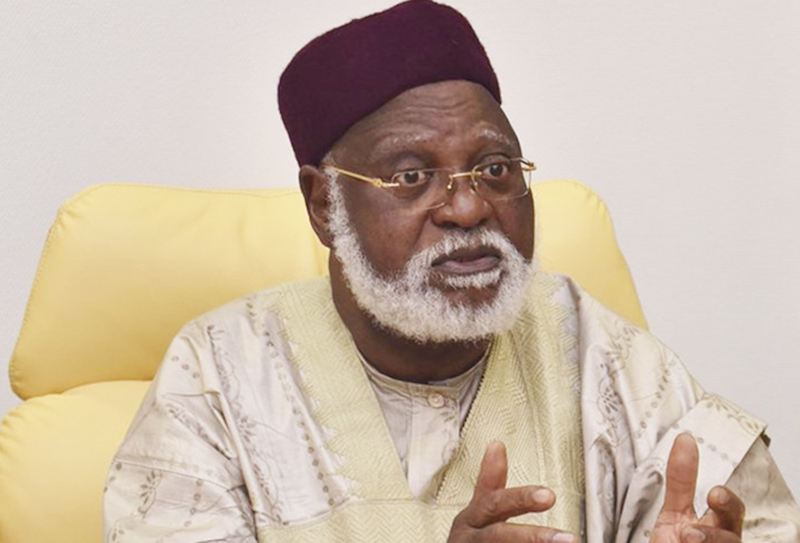
Former Nigerian Head of State, Abdulsalami Abubakar, has rejected claims that Chief MKO Abiola was poisoned while in detention, stating that medical findings and an international autopsy attributed his death to natural causes.
The account appears in his autobiography, Call of Duty, where he revisited the events leading to Abiola’s death on 7 July 1998 while still in government custody. The book was presented at a ceremony in Abuja marking his 84th birthday.
Abdulsalami wrote that Abiola collapsed during a meeting with a visiting United States delegation that included former U.S. Undersecretary of State for Political Affairs Tom Pickering and former Assistant Secretary of State for African Affairs Susan Rice.
He maintained that there was no evidence of poisoning, adding that an autopsy conducted by a team of Nigerian, American, British, and Canadian pathologists concluded the death was due to natural causes.
According to him, Abiola had shown signs of serious health challenges years earlier. He referenced a 1994 medical examination carried out at the Nigerian Army Defence Hospital in Sokoto, which reportedly identified an enlarged heart and hypertensive heart disease.
Recounting the incident, Abdulsalami said Abiola’s condition worsened shortly after the meeting began. He described symptoms including coughing, breathing difficulty, and a sudden feeling of overheating. He added that Abiola briefly left the room before returning in visible distress and collapsing.
Pickering was quoted as saying Abiola struggled to breathe, went to the restroom, and returned severely unwell before collapsing. Rice, in her own account, also described coughing episodes and swelling observed during the meeting.
Abdulsalami further stated that Abiola was rushed to a medical facility when it became clear an ambulance was not immediately available, but efforts to revive him were unsuccessful.
He said he received the news of Abiola’s death through his Chief Security Officer and later informed the family personally, noting the emotional reaction of one of Abiola’s daughters.
Addressing long-standing public suspicion, he argued that allowing foreign officials to witness the situation helped prevent speculation of concealment or foul play.
He also used the memoir to dismiss allegations that he received $500 million after the death of former military ruler Sani Abacha, calling the claim unfounded.
Abdulsalami assumed leadership after Abacha’s death in June 1998 and later supervised Nigeria’s return to civilian rule, handing over power in 1999 to President Olusegun Obasanjo.