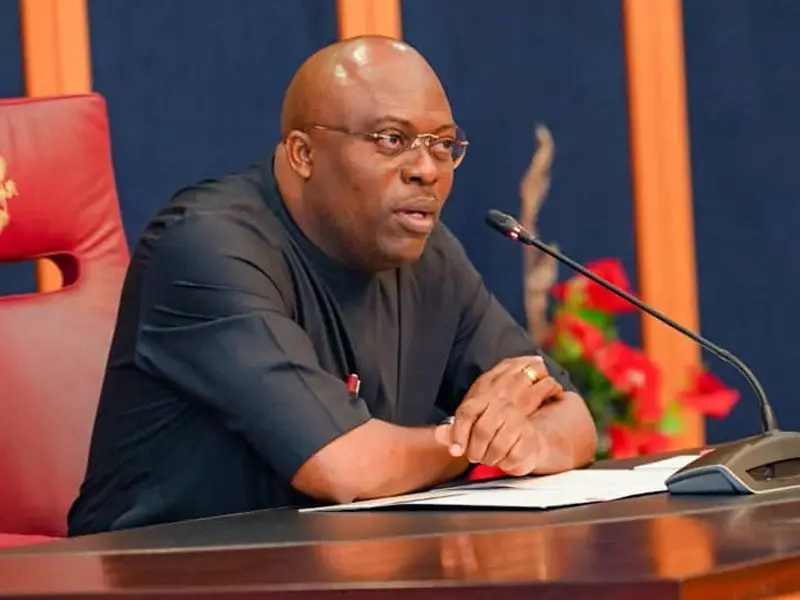
Fresh details from within the All Progressives Congress have shed light on why Rivers State Governor, Siminalayi Fubara, reportedly lost political support from key figures in the Presidency and the party leadership during the ongoing struggle over control of Rivers politics.
Multiple party insiders, including members of the APC National Working Committee and senior figures in Abuja, linked the development to unresolved reconciliation arrangements, disputes over political control in the state, and disagreements surrounding Fubara’s second-term ambition.
One senior APC official, who spoke on condition of anonymity, said the political structure in Rivers had long been aligned around the influence of FCT Minister, Nyesom Wike, and that this shaped how the party managed relations with the governor after his defection from the Peoples Democratic Party.
According to the official, “The President handed over the political structure of Rivers State to Wike. Fubara joined the party to outsmart Wike in a desperate move to secure a second term. But the party leadership already knew the body language of the President.”
The source said this alignment informed why the APC did not organise a formal reception for Fubara after his entry into the party, unlike other governors who defected around the same period and were formally received by senior party leaders.
Another party insider added that early interventions by President Bola Tinubu focused on preventing escalation of the political crisis in Rivers State, particularly during periods when impeachment moves against the governor gained traction in the state legislature.
“The President intervened and saved him from the first impeachment plot,” the official said. “On the second impeachment plot as well, the President told him to focus on governance and leave Wike alone. It was at that time that all parties agreed that he would not go for a second term. Fubara agreed to that, and that is why Wike always says, ‘Agreement is agreement.’”
The same source claimed that although the governor later received political encouragement from different actors within the party, the APC leadership maintained that the earlier understanding remained central to its internal calculations regarding Rivers politics.
“Once the governor settles in Port Harcourt, some people would advise him against Wike again, telling him he is the governor and the leader of the party,” the official said. “But the structure of the Rivers APC primary was given to Wike. Until something changes, he will continue to hold sway in the state.”
A separate APC chieftain in Abuja said Fubara’s withdrawal from the party’s governorship race followed a decision by the screening committee not to clear him for participation in the primary process.
The committee, chaired by APC National Chairman Prof. Nentawe Yilwatda alongside National Secretary Ajibola Basiru, reportedly screened aspirants for the Rivers governorship ticket before the final decision was communicated.
“He was not cleared by the screening committee to contest under the party,” the chieftain said. “That was why he left in anger. He had a very bitter expression when he came out of the screening venue in Abuja. That withdrawal is face-saving. Once you are not cleared, you cannot continue in the process.”
The account was supported by another party figure who insisted the outcome reflected internal party decisions already shaped by earlier political understandings. The source said the decision was not unexpected within party circles, adding that it aligned with prior expectations around the Rivers political structure.
A close associate of the FCT Minister also confirmed that the governor’s ambition was not supported within the APC framework, arguing that the outcome was consistent with prior agreements reached during attempts to stabilise the political crisis in the state.
“Wike has sealed the governor’s fate,” the ally said. “This is not about hostility. It is about honouring an agreement that was already reached. Part of the settlement was that he would not contest for a second term, and he agreed to it.”
The insider further claimed that the APC was operating within the boundaries of that arrangement, particularly as it related to the distribution of political influence in Rivers State ahead of future elections.
While the APC has not issued a formal statement clarifying the screening outcome or the allegations of internal agreements, party officials maintain that decisions around aspirant clearance are routine processes handled by the party’s screening structures.
Fubara’s entry into the APC came on December 9, 2025, after he exited the Peoples Democratic Party. He later visited the party’s national secretariat in Abuja on December 17, where he pledged cooperation with the APC leadership and expressed support for President Bola Tinubu’s political direction ahead of the 2027 general elections.
At the time of his defection, APC National Chairman Yilwatda described the move as politically significant and suggested it reflected broader realignments in the South-South region. However, despite expectations of a formal reception similar to those organised for other governors who joined the party, none was held for Fubara.
Yilwatda later attributed the delay to what he described as regional and religious scheduling sensitivities, saying the party prioritised other political engagements at the time. The explanation, however, did not fully settle internal speculation about Fubara’s position within the party structure.
Tensions surrounding his political standing have also been shaped by repeated impeachment attempts in Rivers State. The first move against him came in late 2023, months after he assumed office, when a significant number of lawmakers backed proceedings that were later suspended following intervention from the Presidency.
A second escalation occurred in early 2025 when political tensions between rival factions in the state legislature intensified. The situation prompted federal intervention, including the declaration of emergency rule in Rivers State, which temporarily suspended the governor and other elected officials before being lifted later in the year.
A third impeachment effort began in early 2026, again triggering political negotiations and renewed attention from Abuja-based stakeholders.
Reactions from political and community stakeholders in the South-South have been mixed, with some expressing concern over the implications for Rivers politics. An elder statesman, Anabs Sara-Igbe, criticised the situation, saying it reflected deeper structural tensions in the state’s political system.
“Rivers people, wake up from your slumber,” he said. “It is time for us to take back our state.”
Ijaw Youth Council leader Ibim Ibiwari also said supporters were disappointed by developments surrounding the governor’s political future, while urging attention to ongoing state projects. A former aide to the governor, Chris Itamunola, questioned the rationale behind stepping away from the contest, arguing that the state had remained politically unstable for years.