
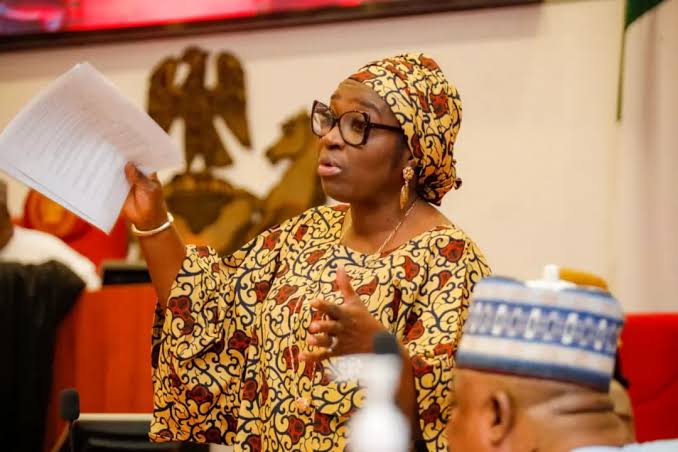
One name that has followed Senator Uche Ekwunife long after her last appearance in the Senate is “Madam Project”. It is an unusual sobriquet for a legislator. In our politics, “project” is more readily associated with governors and other members of the executive who have the authority to award contracts, build roads and commission public infrastructure. Senators make laws, scrutinise government and represent their constituents. So, when a senator is popularly called Madam Project, one would imagine that there is a story behind the name.
There is. And the interesting thing is that Ekwunife did not give herself the name. It came from the people who watched her represent Anambra Central. Whatever else may be said about her politics, it is difficult to discuss her time in the Senate without discussing the development-oriented character of her representation. She appeared to understand early that the office of a senator, although fundamentally legislative, also provides a platform from which a constituency can pursue opportunities, institutions and federal attention.
Her legislative record gives some context to this. Ekwunife sponsored 30 bills and 18 motions, with interests ranging from education and healthcare to technology, environmental protection, electoral reform and economic development. We will return to some of those interventions in greater detail in subsequent editions of this column, because there is quite a lot to examine. For now, it is enough to observe that her legislative interests went beyond the usual politics of attracting a few projects to a constituency. There was an evident interest in institutions that could continue to serve the people long after the senator who initiated them had left office.
The proposed Federal College of Automobile Engineering in Obosi and the Federal College of Commerce and Technical Skills in Abagana are good examples. So also are the proposals for a Federal University of Science, Technology and Innovation in Agulu and a Federal Medical Centre in Umuawulu. Whether all these proposals have reached the point of actual establishment is a separate question, and one that should be properly examined. What is significant for the present discussion is the direction of thought behind them. Ekwunife was looking at education, technical training and healthcare as part of the development equation for her senatorial district.
That brings us to perhaps the less discussed side of the Madam Project story: human capital. A constituency does not become prosperous simply because it has more government buildings. At some point, the people themselves must have the knowledge, skills and opportunities to make something of those investments. This explains the importance of the scholarships, skills-acquisition programmes, employment facilitation, grants and other empowerment initiatives associated with her constituency activities. They may not have carried the same visibility as a major road or public building, but for the individuals and families involved, such interventions could be the difference between dependence and self-reliance.
It is also worth remembering that Ekwunife's legislative interests included technology and innovation at a time when the conversation about Nigeria moving from a consuming nation to a producing nation was becoming increasingly urgent. Her advocacy around NASENI, technical skills and technological transfer fitted naturally into that argument. For a place like Anambra Central, where enterprise is almost part of the local culture, the idea of equipping young people with practical skills and creating an environment where they can produce, repair, manufacture and innovate is hardly an abstract policy proposition.
Perhaps this is why her absence is being discussed today. People have a way of judging political representation by comparison. They compare one period with another, one representative with another, and what they experienced with what they are experiencing. In conversations around Anambra Central, there is a growing feeling among some constituents that the district has not had the same visibility and developmental push since Ekwunife left the Senate. That is a political opinion, and ultimately it is for the electorate to decide whether it is justified. But the fact that the conversation exists is itself significant.
There is another advantage that comes with Ekwunife's proposed return which should not be overlooked: she already knows the place she is trying to get back to. The Senate is not an institution one masters merely by attending plenary sessions. Committee work, legislative procedure, relationships across political lines and familiarity with ministries and federal agencies all count. A former senator returning to the institution comes with a measure of institutional memory that a first-timer necessarily does not possess. Whether that experience translates into better representation is something voters must judge, but it would be unreasonable to pretend that experience has no value.
This is why the call for Ekwunife to return to the Senate in 2027 is becoming louder. And, significantly, she has accepted the call and offered herself again to the people of Anambra Central. That decision now puts the matter where it properly belongs—in the hands of the electorate. They will have to decide whether what she brings to the table is what the district needs at this point in its political journey.
I am particularly interested in the argument for continuity. Development does not always respond kindly to political discontinuity. A legislative idea may require several stages before it becomes a functioning institution; a federal project may require persistent engagement before it is completed; a policy proposal may need someone with sufficient institutional knowledge to keep pushing it. This is not an argument that a former office holder should return simply because she once occupied the office. It is an argument that where experience has been acquired and the people believe it can still be useful, there is nothing unreasonable about putting that experience back to work.
And so, as the 2027 contest gradually takes shape, Anambra Central will have its say. The people will decide whether to look for a new hand or entrust the work again to someone who has already been there, learnt the terrain and built a network within the National Assembly. For Ekwunife's supporters, the answer is obvious. They believe that the district is better served by bringing back a senator whose name became synonymous with projects, empowerment and an assertive presence in Abuja.
That, in the end, may be the simplest explanation for the persistence of the name “Madam Project”. It was not a title conferred at a political ceremony. It was a reputation that grew out of how a significant number of her constituents experienced her representation. Now that she wants to return, the question is whether the people of Anambra Central are prepared to give her another opportunity to put that experience to work.
The answer, as always in a democracy, will be found at the ballot box in 2027.
— Chief Osita Afulukwe