


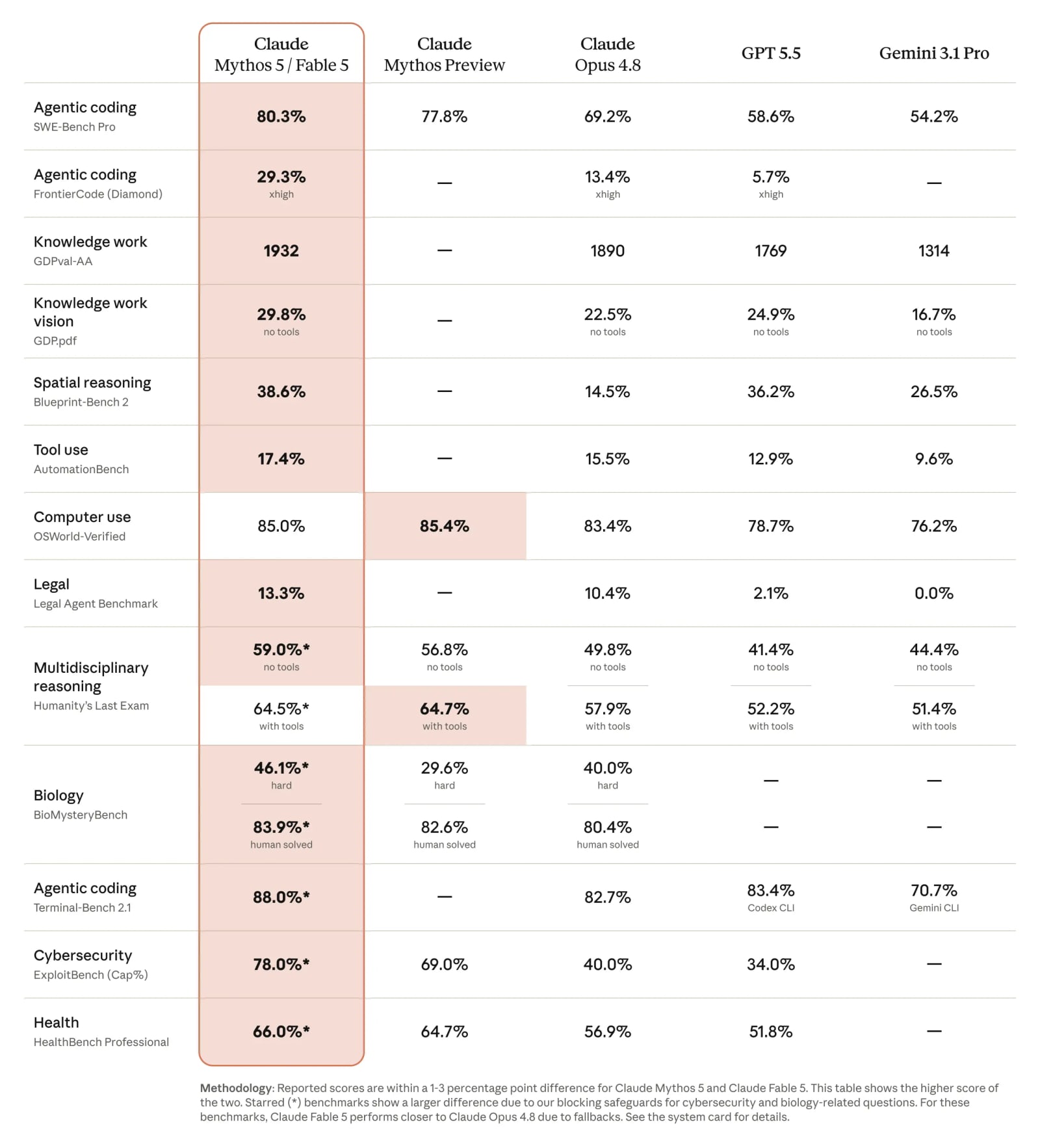
Fable 5 brings Mythos-class intelligence to everyday users and developers for the first time, backed by new safeguards that make the previously restricted model safe enough for broad release.
| Input pricing | $10 per million tokens |
| Output pricing | $50 per million tokens |
| Free access until | June 22 (Pro / Max / Team plans) |
| Generation | 5th — Claude model family |
Anthropic on Tuesday unveiled Claude Fable 5, a new AI model that brings the company's restricted Mythos-level capabilities to the general public for the first time. The launch marks a significant shift for Anthropic, which just two months ago said it had no plans to make Mythos widely available due to its advanced cybersecurity abilities.
Fable 5 is described by Anthropic as "state-of-the-art on nearly all tested benchmarks," with standout results in software engineering, knowledge work, vision, and long-running autonomous tasks — areas where it reportedly outperforms every model the company has previously released to the public.
"The longer and more complex the task, the larger Fable 5's lead over our other models." — Anthropic
What makes Fable 5 different
- Days-long autonomous work — can handle complex tasks for days without human intervention, a major step beyond any previous Claude model
- Advanced vision — understands diagrams, charts, and tables embedded in PDFs and files
- Proactive self-verification — evaluates its own output, builds test harnesses, and refines its approach based on results
- Built-in safety classifiers — high-risk cybersecurity and biology queries are automatically rerouted to Claude Opus 4.8 at no extra cost
- Top of CursorBench — ranks as the leading model on a widely used AI coding evaluation benchmark
The Mythos backstory
Anthropic first unveiled Claude Mythos in April 2026 as a breakthrough model with exceptional skill at identifying security vulnerabilities in software. Because of those capabilities — which raised fears about misuse — access was tightly restricted to a small group of vetted organisations through a cybersecurity initiative called Project Glasswing.
Fable 5 is essentially Mythos with enough guardrails in place to be safe for the general public. Sensitive queries are automatically rerouted, and users are not charged Fable-tier prices when that fallback activates. Separately, a more advanced successor — Claude Mythos 5 — is also launching today, but only for organisations already approved under Project Glasswing.
⚠️ Important for paid subscribers: Fable 5 is available at no extra cost on Pro, Max, Team, and seat-based Enterprise plans through June 22, 2026. After that date it will require usage credits until Anthropic can restore it as a standard subscription feature.
Where you can access Fable 5 today
Fable 5 is available now via the Claude API (model string: claude-fable-5), on Anthropic's claude.ai website and apps, and through Amazon Web Services (Bedrock), Google Cloud, and Microsoft Foundry. Enterprise customers on consumption-based plans get full access immediately.
API pricing is set at $10 per million input tokens and $50 per million output tokens — roughly half the cost of the previous Claude Mythos Preview, though it still ranks among the most expensive frontier models globally. A 90% discount applies to cached input tokens.
The bigger picture
The launch arrives at a pivotal moment for Anthropic. The company is reportedly preparing for a major IPO expected later this year, and Fable 5 is widely seen as a move to capture growing developer and enterprise interest ahead of that milestone.
The timing is also notable because Anthropic made the release just days after publicly urging major AI labs to establish a coordinated slowdown on frontier AI development — citing concerns that models may soon be capable of improving themselves recursively without human oversight, a threshold researchers call recursive self-improvement (RSI).
For everyday users, Claude Fable 5 represents the most capable AI assistant Anthropic has ever offered at scale — one that can take on complex, days-long work that previously required constant human intervention at every step.