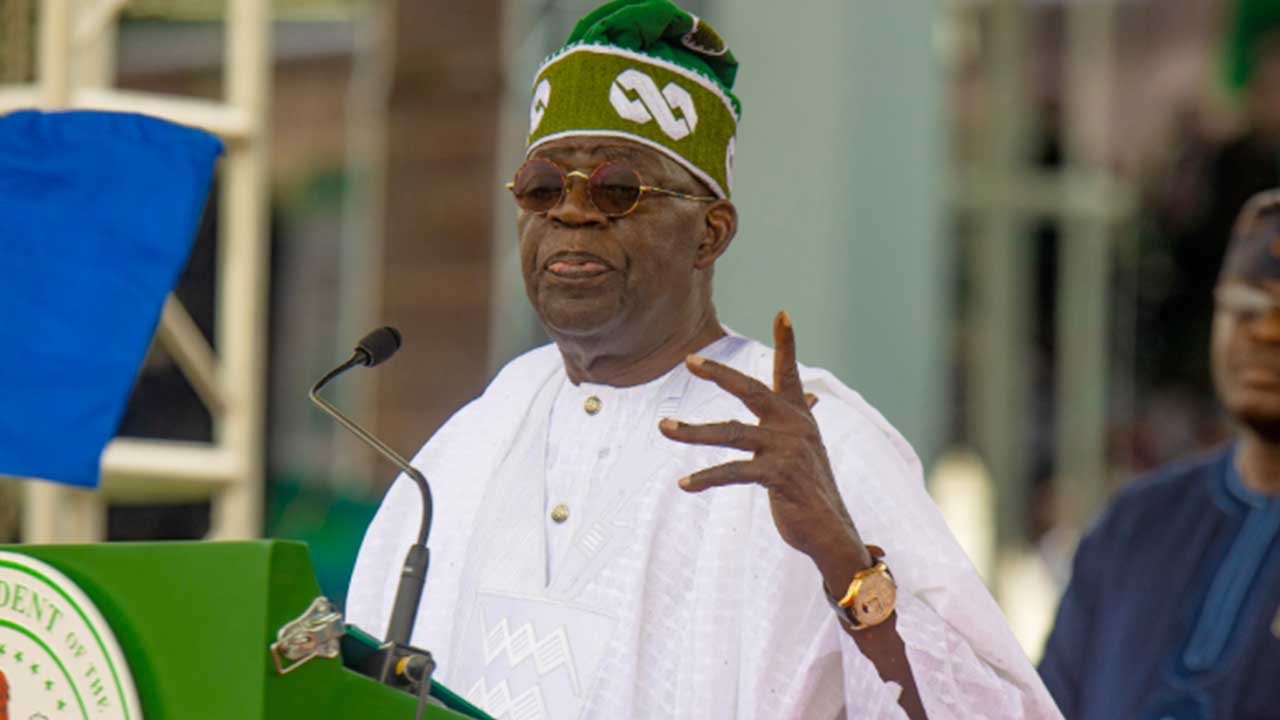
President Bola Tinubu has defended his administration’s decision to remove fuel subsidies, saying the policy rescued Nigeria from an impending financial crisis and created the conditions for economic recovery.
The President made the remarks on Friday while receiving state governors who paid him a Sallah homage and joined the celebration of the third anniversary of his administration at the Presidential Villa in Abuja.
According to Tinubu, the subsidy regime had become unsustainable and was draining public resources that could have been invested in critical sectors such as infrastructure, agriculture, healthcare and education.
He acknowledged that the policy was painful and unpopular at the time it was introduced, but maintained that it was necessary to prevent the country from sliding into fiscal collapse.
“It was challenging at the time, but we survived. We faced litigation and accusations. We survived them. Instead of bankruptcy, Nigeria has survived. The economy has recovered. It is growing. Agriculture is booming,” the President said.
Tinubu noted that his administration took difficult decisions shortly after assuming office because of the state of the economy it inherited. He said years of spending on fuel subsidies had placed a heavy burden on government finances while delivering limited benefits to ordinary Nigerians.
The President argued that ending the subsidy programme enabled government to redirect resources to productive sectors and long-term development projects across the country.
He pointed to ongoing investments in road construction, agriculture, irrigation and power infrastructure as evidence that the reforms were beginning to produce results.
Referring to development opportunities along the Sokoto-Badagry corridor, Tinubu highlighted the potential for irrigation projects, agricultural expansion and electricity generation through dam construction.
“Imagine how many dams on that corridor for irrigation, for farmland, for electricity,” he said.
The President also commended state governors for supporting the administration’s reform agenda despite public criticism and economic challenges. According to him, governors played a key role in persuading citizens to remain patient during the implementation of policies aimed at stabilising the economy.
“You have promoted the perseverance of many of our people, asking them to trust this government,” Tinubu said. “You kept the spirit, you kept the hope. You persuaded our people to be patient and endure these three years of painful reform, during which we put the economy on a reset.”
Tinubu further stated that the relationship between the Federal Government and state governments had improved significantly since the reforms were introduced.
He expressed satisfaction that many states were now in a stronger financial position and no longer depended heavily on federal interventions to meet basic obligations.
“I’m glad governors are no longer borrowing from the federal government and asking for interventions and not knowing how to survive, how to pay salaries, no more,” he said.
According to the President, current economic indicators suggest that the country is gradually moving in a positive direction. He cited improvements in infrastructure development, fiscal management and investor confidence as signs that the reforms are beginning to take effect.
“The economy has recovered. Macroeconomic indices are doing very well. Construction is ongoing on roads and infrastructure; the ones abandoned have been rehabilitated,” he added.
Tinubu assured Nigerians that his administration would continue to pursue policies designed to reduce hardship, create jobs, strengthen food security and promote inclusive economic growth.
Vice President Kashim Shettima also used the occasion to commend the President for taking what he described as bold decisions in the face of strong opposition.
Shettima said Tinubu assumed office at a particularly difficult period in the country’s history and demonstrated the courage required to address long-standing structural problems in the economy.
“Mr President, this is the essence of your leadership. You did not come to power in the season of ease. You came at a time when the house required a builder with the courage to examine the foundation you inherited,” the Vice President said.
He also praised Tinubu’s efforts to tackle corruption and inefficiencies in Nigeria’s oil sector, describing the reforms as necessary for the country’s long-term stability.
Speaking on behalf of the Nigeria Governors’ Forum, Kwara State Governor AbdulRahman AbdulRazaq said the removal of fuel subsidy and other fiscal reforms had significantly improved the revenue available to state governments.
According to him, the increased allocations have enabled many states to clear salary and pension arrears, meet financial obligations and undertake major infrastructure and social investment projects.
AbdulRazaq said the reforms had strengthened the capacity of sub-national governments to deliver development programmes and improve public services.
Governors present at the meeting included those from Lagos, Nasarawa, Jigawa, Sokoto, Kebbi, Taraba, Niger, Ekiti, Delta, Ondo, Edo, Adamawa, Benue, Enugu, Ogun and Kogi states. The deputy governors of Borno and Kano states were also in attendance.
The meeting formed part of activities marking the third anniversary of the Tinubu administration and provided an opportunity for the President and state governors to review the impact of ongoing economic reforms on governance and national development.