
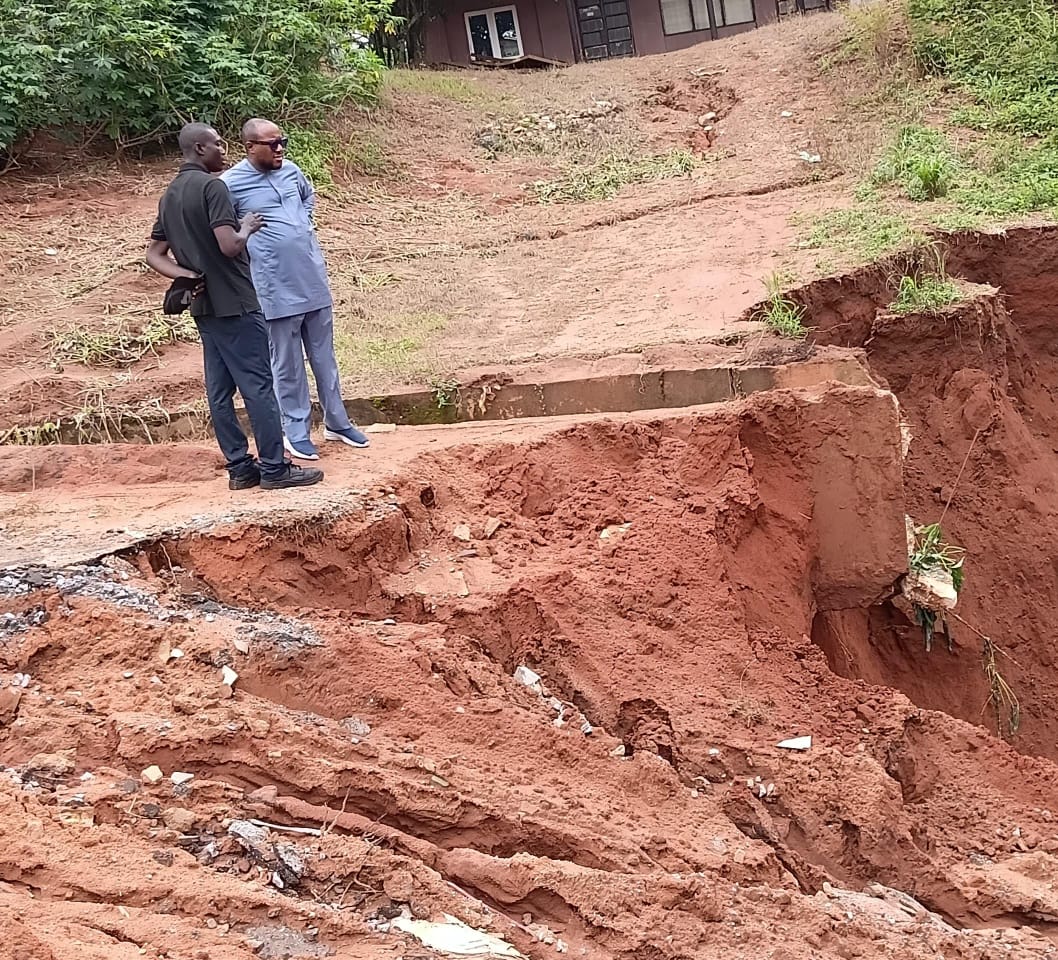
The recent erosion disaster across Obosi, Nkpor and Ogidi should not be reduced to another seasonal environmental incident. It exposed, once again, the vulnerability of communities in Idemili to flooding, gully erosion and inadequate drainage infrastructure. Homes and properties were placed at risk, and residents were compelled to confront a danger that plainly exceeds the capacity of individual households.
Yet, in the midst of that crisis, the response to the Ugamuma incident in Obosi provides a useful and revealing case study in leadership.
When the extent of the damage became known, Engr. Eric Anyamene mobilised engineers from Abuja and commenced remedial work without waiting for government intervention. He acted because people were in danger and because something had to be done immediately. That decision, viewed objectively, says much about his understanding of responsibility.
The significance of the intervention lies not merely in the money or machinery deployed. It lies in the mindset behind it. Anyamene saw a serious problem affecting his people and assumed responsibility for doing what he could, with what he had, while simultaneously pursuing the intervention of the State and Federal Governments.
That is an important distinction.
Government remains responsible for the permanent solution to the erosion crisis. But public administration, by its nature, involves processes, assessments, approvals and funding. Those processes are necessary, but they take time. Erosion does not wait for bureaucracy. Where immediate action can prevent additional damage, the willingness to act is evidence of practical leadership.
The Ugamuma response also brings another important quality into focus: network and reach.
Representation is not merely the ability to speak. It is also the ability to get the right people to listen. It requires relationships, access and the capacity to move an issue from the community level to the institutions with the authority and resources to address it.
Anyamene demonstrated that capacity. The Ugamuma crisis did not remain confined to the immediate community. It attracted the attention of State and Federal authorities and generated a wider conversation about the erosion crisis confronting Idemili.
That is precisely the kind of reach that becomes important when a constituency is confronted by problems that cannot be solved at the local level.
There is also the question of personal commitment. Anyamene did not simply issue a statement or wait for public authorities to arrive. He committed his own resources to emergency remedial work and remained personally involved in monitoring the intervention.
For a man whose public life is increasingly associated with service to his people, that action provides something more valuable than rhetoric: evidence.
It is therefore difficult to sustain the attempt to portray his intervention as nothing more than an effort to protect his own property.
Even if his property was among those exposed to the danger, the erosion did not recognise property boundaries. It threatened neighbouring buildings and residents as well. By intervening, he was helping to protect the wider community from further destruction.
The principle that charity begins at home is particularly relevant here. Concern for one's immediate community is not evidence of selfishness. It is often the first and most credible expression of a person's commitment to public service.
Indeed, one of the clearest lessons from Ugamuma is that Idemili must remain personal to those who seek to serve Idemili. The people, their homes, their roads, their environment and their everyday difficulties cannot be abstract matters to anyone entrusted with representing them.
This is where the Ugamuma episode acquires significance beyond the erosion site itself.
It demonstrates in practical terms a combination of initiative, access, personal commitment and responsiveness. It shows a man prepared to use his own resources, mobilise technical capacity, engage government and remain present while a solution is pursued.
Most importantly, it shows an Idemili-first instinct: when something threatens the people, the first response is not to ask who will get political credit, but what can be done to reduce the danger.
The permanent solution to the erosion crisis, of course, requires government-backed engineering, proper environmental planning, effective drainage and channelisation, sustained funding and institutional coordination. The scale of the problem across Obosi, Nkpor and Ogidi makes that unavoidable.
But while government works towards that permanent solution, someone must be willing to raise the alarm, mobilise resources and prevent an emergency from becoming a catastrophe.
At Ugamuma, Eric Anyamene did exactly that.
And that is perhaps the most important lesson from the episode. Leadership is not simply about promises of what a person will do when given responsibility. It is also revealed by what he does when his people are already in trouble.
In Ugamuma, Anyamene's response has provided a practical demonstration of a leadership instinct that is difficult to manufacture: see the problem, respond quickly, mobilise the right people, use whatever resources are available and keep pushing until those with greater institutional capacity take up the responsibility.
That is the record that should be examined. Not the insinuations, not the politics of distraction, but the action taken when the people needed it.