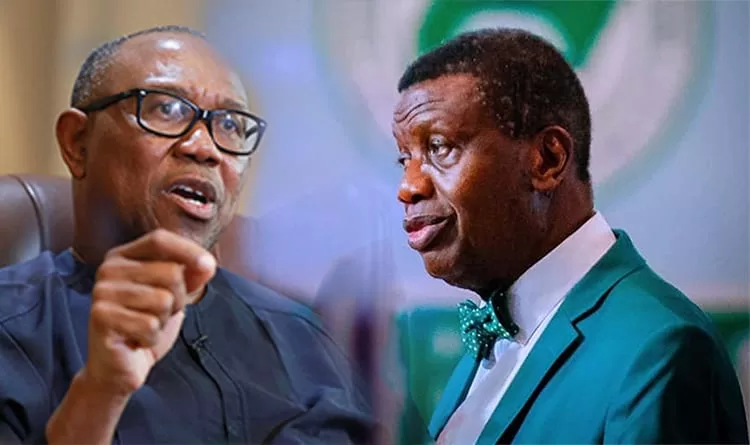
Presidential candidate of the Nigeria Democratic Congress, Peter Obi, has cautioned young Nigerians against placing civic responsibility on religious leaders, saying such expectations are misplaced.
He made the statement in a post shared on X on Thursday amid online criticism of cleric Enoch Adeboye over insecurity in the country, where some users called for stronger public intervention from him.
Obi said it is not appropriate to expect religious figures to assume duties that belong to citizens and political actors.
“At 84 years of age, it would be unfair for young and able-bodied Nigerians to transfer to him responsibilities that properly belong to them,” he said.
He argued that national progress depends on citizens taking responsibility rather than shifting expectations to spiritual leaders.
Obi also warned that public discourse ahead of future elections is increasingly shaped by ethnic and religious narratives. He noted that during the 2023 elections, particularly in Lagos, debates that should have focused on governance and development were diverted toward identity-based sentiments.
“Today, I see similar efforts emerging again, sometimes in more subtle and sophisticated ways. Narratives are planted, amplified, and circulated, often by individuals who genuinely believe they are defending a worthy cause, without recognizing the broader agenda behind such campaigns,” he said.
According to him, many well-meaning Nigerians unknowingly become part of narratives that deepen suspicion and division.
He added that politicians who cannot compete on ideas, performance, character, and vision often resort to identity politics.
Defending Adeboye, Obi described him as a respected faith leader who has consistently promoted peace, unity, and reconciliation.
"Let me state clearly that Pastor Enoch Adeboye remains one of the foremost fathers of faith in our nation. For decades, he has consistently preached the virtues of peace, prayer, love, reconciliation, and national unity,” he said.
Obi urged young Nigerians to take greater responsibility in shaping national conversations, driving reforms, and resisting narratives that promote division along ethnic or religious lines.