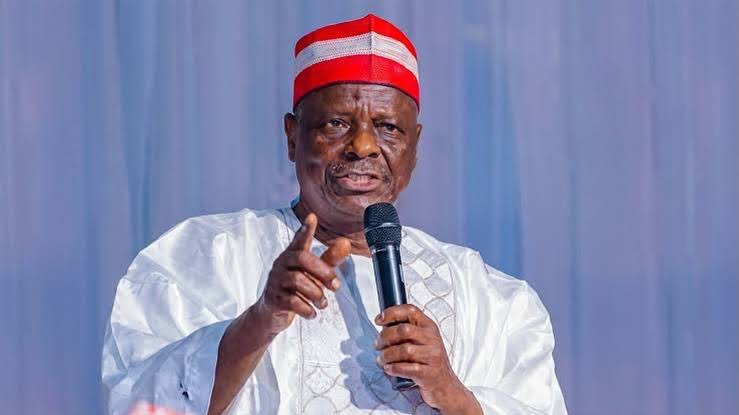
Former Kano State Governor, Rabiu Kwankwaso, says a potential vice-presidential ticket under the Nigeria Democratic Congress (NDC) could position Kano State for a future presidential breakthrough in Nigeria.
Kwankwaso made the remarks on Sunday during a media tour of radio stations in Kano, where he spoke on ongoing political realignments ahead of the 2027 general elections.
He said the emerging coalition politics presents what he described as a rare opening for Kano’s long-term national ambition.
“My vice-presidential ticket is a one-way route to the presidency for the people of Kano,” he said.
He argued that no indigene of Kano has held the office of Vice President since independence, describing the situation as a political gap the state must work to correct.
“This is imperative for the people of Kano because, since the inception of the First Republic to date, no Kano indigene has ever emerged as a vice-presidential candidate, despite our massive population and deep political experience,” he said.
Kwankwaso added that securing the position would not be the end goal, but part of a longer political calculation.
“We are going to correct this historical anomaly if we secure the ticket,” he said.
He also suggested that a vice-presidential position would strengthen Kano’s chances of producing a president in the future, urging supporters to see the 2027 election as a strategic moment for the state.
“We are calling on our supporters in Kano, across the North-west, and throughout the country to do the needful: register and vote,” he said.
Kwankwaso further addressed his alliance with former presidential candidate Peter Obi under the NDC platform, saying votes for the coalition should be seen as support for both the ticket and Kano’s political interests.
In the same interviews, he criticised Governor Abba Yusuf over his defection from the New Nigeria People’s Party (NNPP) to the All Progressives Congress (APC), describing it as a serious political setback for the movement he once led.
He said the development would be judged by voters in the next election cycle.
Governor Yusuf had joined the APC earlier alongside most elected officials in Kano, a move that reshaped the state’s political alignment ahead of 2027.
Kwankwaso also pointed to broader opposition realignments, noting that his former party, the NNPP, had given way to shifting alliances involving the African Democratic Congress (ADC) and the emerging NDC coalition.
The political tension in Kano continues to deepen ahead of 2027, with Kwankwaso positioning the NDC alliance as a central platform for opposition forces seeking to challenge the ruling party led by President Bola Tinubu, while his long-standing rivalry with former Kano governor Abdullahi Ganduje remains a key feature of the state’s political landscape.