
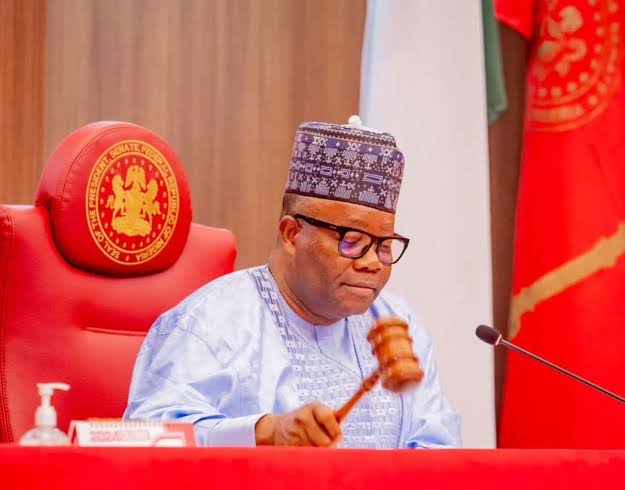
Senate President Godswill Akpabio has said the National Assembly will continue to cooperate with President Bola Tinubu’s administration where such partnership serves the interest of Nigerians, stressing that collaboration should not be interpreted as a loss of legislative independence.
Akpabio made the remarks on Tuesday while declaring open the 2026 National Assembly Open Week in Abuja.
He said the legislature’s responsibility was not to create unnecessary disagreements with the executive arm of government but to support policies that advance national interests while maintaining its constitutional duty of oversight.
“Constructive partnership should never be mistaken for constitutional surrender. Parliament does not prove its independence by manufacturing conflict, nor its relevance by opposing for opposition’s sake,” Akpabio said.
“Our constitutional duty is to support what advances the national interest, to question what requires scrutiny, and to correct what demands improvement. That is the balance we have sought to maintain, and history, I believe, will judge it fairly.”
The Senate president said the National Assembly was established to serve Nigerians and must remain open and accessible to citizens.
“These walls were never meant to keep Nigerians out. They were built to welcome them in — not merely as spectators of democracy, but as its rightful owners,” he said.
He added that parliament belonged to the people whose votes brought lawmakers into office.
“Parliament belongs not to those elected to sit within it, but to the millions whose hopes and votes brought it into existence,” Akpabio said.
Akpabio said transparency and accountability were essential to sustaining public confidence in democratic institutions.
“Public confidence is earned not by asking citizens to trust institutions blindly, but by embracing transparency and accountability,” he said.
“Parliament should never fear informed criticism. Questions strengthen democracy. Transparency strengthens legitimacy. The more Nigerians understand our work, the stronger our democracy becomes.”
He encouraged citizens to participate more actively in legislative activities by attending public hearings, reviewing lawmakers’ actions and holding representatives accountable.
“We invite Nigerians not merely to observe us, but to engage with us; not merely to applaud where they agree, but to challenge us where they believe we can do better,” he said.
“A parliament that listens becomes wiser. A democracy that listens becomes stronger.”
Highlighting the achievements of the 10th National Assembly, Akpabio said lawmakers had passed more than 100 bills within their first three years, describing the record as significant in Nigeria’s democratic history.
He listed legislation covering national security, education, tax reforms, the new national minimum wage, investment promotion and the creation of regional development commissions among the measures passed by the assembly.
The Senate president also said the legislature had handled the screening and confirmation of public officeholders with the seriousness required by the constitution.
He further noted that Nigeria’s return to the executive committee of the Inter-Parliamentary Union after nearly six decades reflected renewed international recognition of the country’s democratic institutions.
Akpabio said the Senate and House of Representatives had maintained “uncommon harmony and mutual respect” in the last three years.
Speaking directly to Nigerians, he urged citizens to see parliament as their institution and remain involved in its activities.
“Whether you are with us today, following these proceedings online, listening on radio, watching on television, or gathered beneath a mango tree in a village square, this parliament belongs to you,” he said.
“Come closer. Attend our public hearings. Read the laws we make. Question us. Challenge us. Encourage us. Democracy flourishes when citizens remain active participants in the work of self-government.”
He said the Open Week programme was aimed at improving public understanding of the legislature and strengthening the relationship between lawmakers and citizens.
“The true measure of parliament is not the height of its walls, but the depth of its people’s confidence,” Akpabio said.