

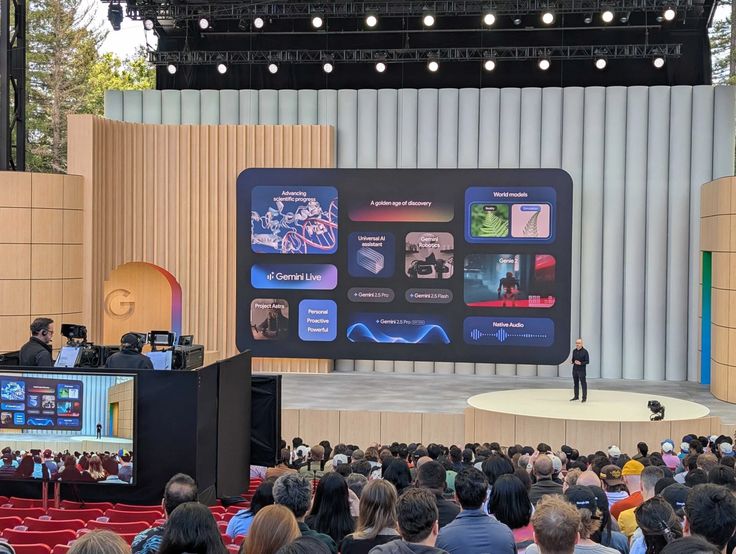
Every year, Google holds its annual developer conference known as Google I/O — an event where the company pulls back the curtain on its biggest product plans, new technologies, and the direction it is heading. Google I/O 2026 was different from previous years in one very significant way: for the first time, it was not just a showcase of Google's products. It was a declaration that Google is rebuilding everything it has ever made, from the ground up, around artificial intelligence.
The name at the center of it all? Gemini.
What Is Google I/O and Why Does It Matter?
For those unfamiliar, Google I/O is an annual conference held in Mountain View, California, where Google announces major updates to its products, platforms, and developer tools. It is attended by thousands of developers, engineers, and tech enthusiasts from around the world, and millions more watch the livestream online.
This year's event was headlined by Google CEO Sundar Pichai, who opened the keynote with a clear message: Google is no longer treating AI as an add-on feature. AI is now the foundation that every single Google product is being built around.
New Gemini Models: Faster, Smarter, More Capable
The biggest headlines from I/O 2026 centred on a wave of new AI models under the Gemini brand.
Gemini 3.5 Flash was officially launched, combining frontier intelligence with the ability to perform agentic tasks — meaning it can take actions on your behalf, not just answer questions. It surpasses the previous Gemini 3.1 Pro in coding, agentic, and multimodal benchmarks, while running at four times the speed of other frontier models in terms of output tokens per second. 9to5Google
Gemini Omni is a new series of models that blends Gemini's reasoning capabilities with content creation. The Omni Flash model accepts image, audio, video, and text as input and can output video grounded in real-world knowledge. 9to5Google
Gemini 3.5 Pro is currently in testing and is expected to be available next month, promising even more powerful capabilities for professional and enterprise users. 9to5Google
AI Agents: Google's Biggest Shift Yet
Perhaps the most important theme of I/O 2026 was the shift from AI assistants to AI agents. An assistant answers your questions. An agent actually goes and does things for you.
Google detailed over 100 advancements in AI agents and models at the keynote, shifting the focus firmly from assistants to autonomous agents capable of handling multi-step workflows across apps and services. Google
Google introduced Gemini Spark and a Daily Brief feature inside the Gemini app, as well as a Universal Cart — described as a truly intelligent shopping cart that brings AI superpowers to the online commerce experience. Google
The Gemini app is also preparing deeper integrations with third-party apps, with support documents suggesting compatibility with Canva, Instacart, and OpenTable is on the way — meaning Gemini could soon control these apps on your behalf based on simple prompts. Tom's Guide
Google Search Gets an AI Overhaul
Search — the product that built Google into one of the most valuable companies in history — is also being fundamentally reimagined.
Using the power of Google's Antigravity platform and the agentic coding capabilities of Gemini 3.5 Flash, Search can now build custom result formats tailored specifically for whatever question you ask, rather than returning the same list of blue links for everyone. Google
Google described this as bringing together the best of a traditional search engine with the best of AI — a hybrid approach that could significantly change how billions of people find information online. Google
Smart Glasses, YouTube AI, and More Hardware
I/O 2026 was not all software. Google also made moves in hardware and wearable technology.
Google announced its first audio glasses, developed in partnership with Gentle Monster, Warby Parker, and Samsung, set to arrive this coming fall and compatible with both Android and iOS devices. Google
New voice capabilities are coming to Gmail, Docs, and Keep, alongside a new design tool called Google Pics and updates to AI Inbox. Google also introduced Ask YouTube, a new AI-powered feature that lets users interact with YouTube content in new ways. Google
Protecting AI-Generated Content with SynthID
As AI-generated content floods the internet, knowing what is real and what is artificially created has become a serious concern. Google addressed this directly.
Google's SynthID technology, which embeds invisible watermarks into AI-generated content, has already been used 50 million times globally. Google announced it is now expanding SynthID verification to Search and Chrome in the coming weeks, allowing users to check whether content they encounter has been AI-generated or altered. Google
This is a meaningful step toward building trust in an internet increasingly shaped by AI tools.
What This All Means
The scale of what Google announced at I/O 2026 is hard to overstate. Google is no longer treating AI as a layer on top of its products — it is rebuilding the entire product stack around Gemini. With massive distribution across search, mobile, email, browsers, video, and cloud, Google is turning its ecosystem into a full-stack AI platform. Tech Startups
For everyday users, this means the Google products you already rely on — Search, Gmail, YouTube, Android — are about to become dramatically more intelligent. For developers, it opens up a new generation of tools for building AI-powered applications. And for the broader tech industry, it signals that the AI race is no longer about which company has the best chatbot. It is about who controls the full infrastructure of intelligence that people use every day.
Google I/O 2026 made one thing crystal clear: the AI era is not coming. It is already here — and Google intends to lead it.