
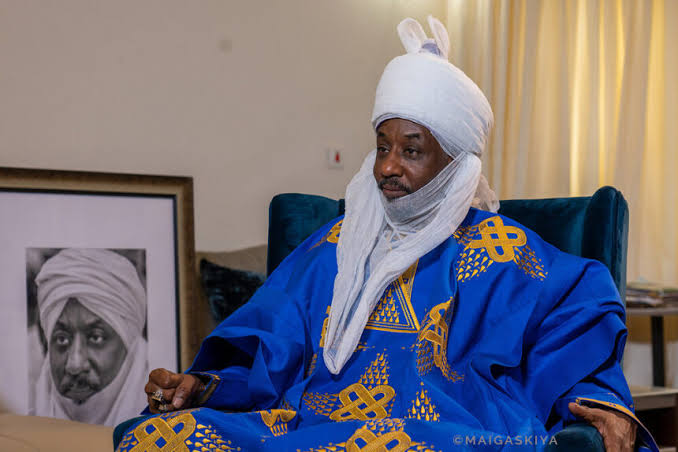
The Emir of Kano and former Central Bank of Nigeria (CBN) Governor, Lamido Sanusi, has acknowledged improvements in Nigeria’s economic performance under President Bola Tinubu but warned that millions of citizens are yet to feel the benefits of the reforms.
Mr Sanusi said the government had helped stabilise the economy after years of weak growth but stressed that economic progress must be accompanied by policies that protect low-income households from rising hardship.
He made the remarks on Tuesday at the Oxford Global Think Tank conference, where he urged the federal government to pay greater attention to the social consequences of its economic policies.
The former CBN governor identified improvements in key economic indicators, including economic growth, inflation, foreign reserves and non-oil exports, as signs that Nigeria’s economy was recovering.
He cited the country’s Gross Domestic Product (GDP) growth of 4.48 per cent in the second quarter of 2026, describing it as an improvement on the performance recorded during the administration of former President Muhammadu Buhari.
According to him, Nigeria’s economy grew by an average of 0.9 per cent during the Buhari years, rising to 1.8 per cent when the COVID-19 pandemic years were excluded.
Although the current growth rate remains below the 6–7 per cent recorded during parts of the administrations of former Presidents Umaru Musa Yar’Adua and Goodluck Jonathan, Mr Sanusi said the improvement should be recognised.
He also pointed to a decline in inflation from above 30 per cent in recent years to 14.6 per cent, with projections indicating that it could fall to between 12 and 12.5 per cent next year.
Mr Sanusi attributed the improvement partly to the Central Bank’s aggressive monetary tightening, which he said had helped moderate price increases and could create room for monetary policy easing.
He further identified Nigeria’s external reserves, which stood at $55 billion, as another positive indicator, supported by higher crude oil prices and foreign portfolio inflows.
The former central bank governor also said GDP per capita in dollar terms increased by 47 per cent in 2023, reflecting economic growth and an improvement in the exchange rate.
On the contribution of the private sector, he highlighted the Dangote Refinery’s role in boosting non-crude exports.
According to him, the refinery contributed approximately $4 billion to exports in the second quarter of 2026, exporting 50 per cent of its diesel production and 85 per cent of its aviation fuel output.
Despite these developments, Mr Sanusi cautioned that Nigeria’s economic recovery remains vulnerable to external shocks, particularly fluctuations in foreign portfolio investments.
Poor Nigerians still bear the burden
Beyond the improving economic figures, Mr Sanusi said the government must address the difficulties facing ordinary Nigerians, particularly those at the bottom of the economic pyramid.
He questioned the state of education, healthcare, maternal mortality, malnutrition and hunger, arguing that these issues should be central to any assessment of the country's economic progress.
“At the end of the day, we’ve got to look at the human beings at the bottom of the pyramid.
“What’s happening to human beings? What’s happening to education? What’s happening to healthcare? What’s happening to maternal mortality? What’s happening to malnutrition? What is happening to hunger?” he asked.
He also expressed concern about disparities in wealth distribution across different regions, noting that although poverty had declined in some areas, many Nigerians had fallen below the poverty line without adequate support.
Mr Sanusi said the government should have anticipated the impact of its economic reforms on vulnerable citizens and introduced measures to cushion the effects.
“When we started these reforms, we should have known that there was going to be an impact on people at the bottom of the pyramid, and we should have designed policies that would try to minimise those shocks,” he said.
He described the failure to adequately address these consequences as a major gap in the implementation of the reforms.
Call for stronger social protection
Mr Sanusi maintained that improvements in macroeconomic indicators should not be the only measure of the government's performance.
He said the long-term success of the reforms would depend on whether Nigerians, particularly low-income earners, experience better living conditions.
He therefore called for functional social safety nets to protect vulnerable households and reduce the hardship associated with the government's economic policies.
While acknowledging the administration's efforts to improve economic stability, he stressed that the government must ensure that the gains of recovery translate into tangible benefits for ordinary citizens.