
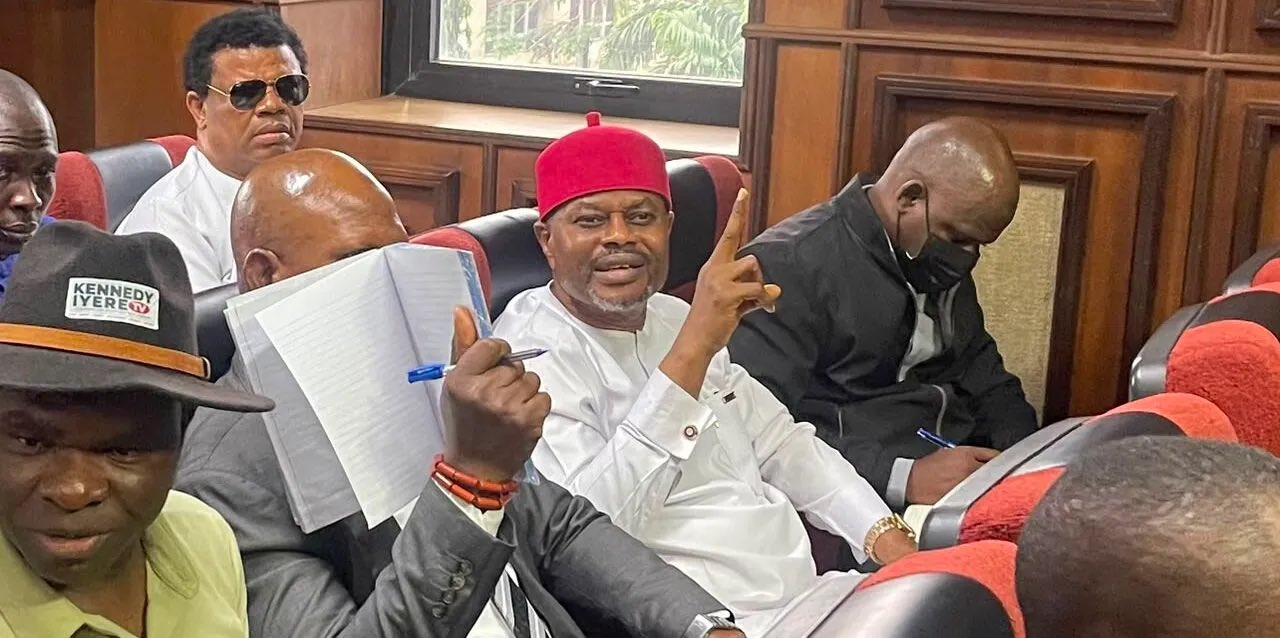
Nnaji was arraigned on Monday before Justice Joyce Abdulmalik of the Federal High Court in Abuja by the Independent Corrupt Practices and Other Related Offences Commission (ICPC).
According to the charges, the former minister allegedly presented a forged degree certificate from the University of Nigeria, Nsukka (UNN), and a forged National Youth Service Corps (NYSC) discharge certificate during his ministerial screening in 2023.
The ICPC also accused him of receiving about ₦29.5 million in salaries and other emoluments under false pretences while serving in office.
Nnaji pleaded not guilty to all six counts.
His counsel, Senior Advocate of Nigeria (SAN) Ogwu Onoja, applied for bail, while the prosecution said it had no objection to the application and left the decision to the court.
Justice Abdulmalik granted the defendant bail in the sum of ₦20 million with one surety in like sum.
The court ruled that the surety must be a federal civil servant not below Grade Level 15, have maintained a fixed place of residence for at least four years, and provide proof of employment, including a letter of appointment and salary slips for the last three months. The court also directed the relevant authority to verify the surety's employment status.
Nnaji was further ordered to deposit his international passport and other travel documents with the court.
The judge adjourned the matter until September 21, 2026, for the commencement of trial.
The ICPC arrested Nnaji on July 1 after executing a bench warrant issued by the Federal High Court. The commission said he was arrested at the Nnamdi Azikiwe International Airport, Abuja, with the assistance of the Department of State Services (DSS).
According to the commission, the former minister failed to honour several invitations issued in May 2026 over allegations that he forged his UNN degree certificate and NYSC discharge certificate, prompting the agency to obtain a court order for his arrest.
Nnaji resigned as minister in October 2025 following the allegations. He maintained that his resignation was not an admission of guilt but a decision to allow the judicial process to proceed without affecting the work of the ministry. He also insisted that he graduated from the University of Nigeria, Nsukka, and described the allegations against him as politically motivated.