
The Secretary to the Government of the Federation (SGF), Senator George Akume, has said President Bola Tinubu’s administration is willing to strengthen its engagement with the Catholic Bishops’ Conference of Nigeria (CBCN), other faith-based organisations and relevant stakeholders on issues affecting the country.
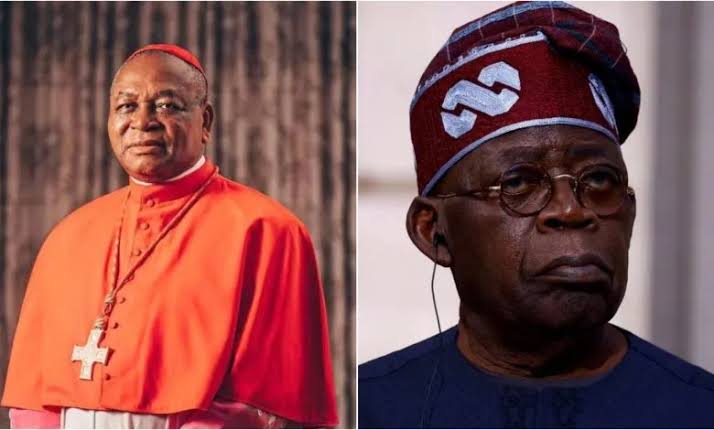
Akume stated this in a statement on the recent meeting between President Tinubu and the leadership of the Catholic Bishops’ Conference of Nigeria, assuring that the government would continue consultations and dialogue with religious institutions in the interest of national development.
He said collaboration with faith communities, traditional institutions, civil society organisations, the private sector and citizens was essential to addressing Nigeria’s challenges and promoting peace and social cohesion.
“Many of the challenges confronting our nation require partnership. Faith communities, traditional institutions, civil society, the private sector and citizens all have indispensable roles to play in promoting peace, strengthening social cohesion and advancing national development,” Akume said.
“Constructive engagement between government and these institutions is therefore not only welcome but essential.”
The SGF said the government recognises the Catholic Church as an important development partner because of its contributions to education, healthcare, humanitarian services, peacebuilding and moral guidance.
He said the meeting between President Tinubu and the bishops was conducted in a respectful and constructive manner, with discussions covering security, economic hardship, public services, education, electoral credibility, political pluralism and religious freedom.
Akume said both sides acknowledged progress made by the administration, including the student loan programme and recent successes by security agencies in rescuing abducted schoolchildren and teachers.
He added that differences in views between government and religious leaders should not be interpreted as a breakdown in relations, but as part of democratic engagement aimed at improving the country.
The SGF acknowledged the economic difficulties faced by many Nigerians but said the government’s reforms were targeted at correcting structural weaknesses, stabilising the economy and creating sustainable growth.
He pointed to investments in rail transport, the Sokoto-Badagry and Lagos-Calabar superhighways, road construction and rehabilitation nationwide, as well as improvements to Abuja’s road network, as part of efforts to drive development.
Akume also highlighted agricultural initiatives involving improved inputs, tractors and support through the National Agricultural Land Development Agency (NALDA), saying the measures were aimed at boosting food production.
He said the administration was pursuing improvements in electricity generation and distribution through CNG power stations and constitutional reforms that allow sub-national governments to participate more actively in the energy sector.
According to him, health facilities are being upgraded, while development commissions across the country are creating jobs and addressing regional needs.
Defending the economic reforms, Akume said the measures were difficult but necessary to restore macroeconomic stability, rebuild investor confidence and place the economy on a stronger footing.
He said recent developments showed signs of improvement, including greater stability in the foreign exchange market, easing inflationary pressures and strengthening economic fundamentals.
Akume said government interventions such as the Social Investment Programmes, Credit Corps, NELFUND, support for business start-ups and Conditional Cash Transfers were designed to ensure Nigerians benefit from ongoing reforms.
On security, the SGF said the government remained committed to protecting citizens and improving safety across homes, farms, schools, markets, places of worship and highways.
He admitted that terrorism, banditry, kidnapping and other violent crimes remained major concerns but said the administration was strengthening the country’s security framework.
Akume cited the establishment of four new Army divisions in Benue, Kwara, Taraba and Edo states as part of measures to improve operational effectiveness.
He added that President Tinubu had approved reforms in intelligence coordination, logistics, recruitment, technology and personnel welfare, while the establishment of the Office of Homeland Security reflected the administration’s commitment to strengthening domestic security.
On democracy, Akume reaffirmed the government’s commitment to constitutional rule, political competition and the independence of the Independent National Electoral Commission (INEC).
He said the Tinubu administration neither seeks nor supports a one-party state, stressing that Nigeria’s democracy allows for opposition parties, credible elections and citizens’ participation.
“The Federal Government neither seeks nor supports a one-party state,” Akume said, adding that the administration would continue to respect INEC’s legal independence.
He said the government would remain open to advice from national institutions and stakeholders, noting that responsible governance requires listening to citizens’ concerns.
“Although government and the Catholic Church may not always share identical views on every policy, both remain united by the common aspiration of ensuring that every Nigerian lives in peace, dignity and hope,” Akume said.
“Our diversity is our source of strength. In spite of many, we are one people.”