
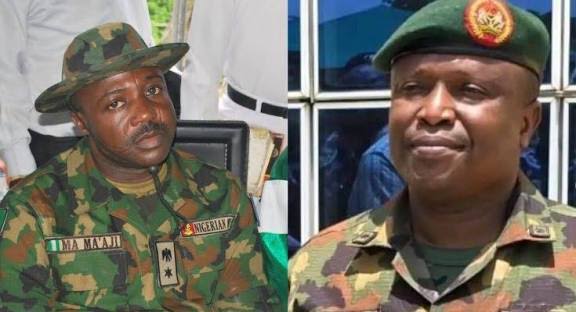
Nigerian Army Colonel Mohammed Ma’aji has told military investigators that he planned to overthrow President Bola Tinubu’s government because of what he described as worsening insecurity, corruption, economic hardship and poor governance.
Mr Ma’aji, who was arrested in September 2025 during investigations into an alleged coup plot, said the plan was driven by a desire to “save” Nigeria from further decline.
His account is contained in interrogation statements published by Premium Times as part of thousands of pages of documents relating to the investigation. The documents include bank statements, financial records, hotel receipts, electronic communications and statements from people questioned by military investigators.
The allegations contained in the documents have not been established as facts. Mr Ma’aji and other defendants have denied wrongdoing, while courts are still determining the admissibility of some interrogation statements and the guilt or innocence of those facing trial.
According to Mr Ma’aji, the idea of military intervention began towards the end of former President Muhammadu Buhari’s administration in 2023.
He said corruption, insecurity, kidnapping and banditry had reached alarming levels, particularly across northern Nigeria, while the military leadership failed to take action.
“Things particularly got out of control towards the end of Buhari’s administration when corruption and nepotism became the order of the day,” he said.
He added: “It was expected that the higher hierarchy of the military could have acted to save the situation. Unfortunately, there was no action from the top.”
Mr Ma’aji said he began identifying military officers who shared his concerns about the country and could be brought into the movement.
“Most of the officers involved share the same sense of patriotism, love of country and genuine desire for positive change,” he said.
He said the initial plan was abandoned because of inadequate funding, logistics and manpower.
According to him, he financed much of the activity from his personal resources and sold three houses in Kaduna State as well as a students’ hostel at Ahmadu Bello University, Zaria.
“Most of the money spent were my personal resources generated through sells of my personal property coupled with sacrifice and contributions from some members,” he said.
Mr Ma’aji said the movement was revived in 2024 after he failed for a second time to secure promotion to the rank of brigadier general.
“When I missed my second attempt at promotion to brigadier general in 2024, some of the boys started disturbing and calling on me that we needed to revive the movement again,” he said.
He identified Lieutenant Colonel Shamsuddeen Bappah as one of the officers who pushed for the revival of the plan.
Mr Ma’aji said Bappah travelled from Ibadan to Abuja to persuade him to proceed despite concerns over funding.
“I told him I was not in a good financial state because he was aware that I had sold all my property in the course of the movement. But he insisted that we have to carry out the plan.”
He said meetings were subsequently held at different locations in Abuja, including Brookville Hotel and Greenland Hotel in Lokogoma.
Mr Ma’aji said, however, that his failed promotion attempts were not the main reason for the alleged coup plot. He said the group believed the country had deteriorated further under Mr Tinubu.
He listed the removal of fuel subsidy, the floating of the naira, taxes, electricity tariff increases, corruption and insecurity among the issues that angered members of the movement.
“The issue of fuel subsidy removal, floating [of naira], dubious taxes, multiple taxation, and electricity tariff hike were all of major concerns,” he said.
He also criticised the government’s handling of youth protests and the condition of military veterans.
Mr Ma’aji said young Nigerians were increasingly frustrated by unemployment, lack of opportunities and what he described as a lack of hope for the future.
“An average Nigerian youth today is a frustrated human being without a job, a means of livelihood and hope for the future,” he said.
In his statement, the colonel rejected the suggestion that his actions were motivated by personal ambition.
“This has nothing to do with any ambition or personal goals. It is purely out of the desire for a prosperous country that works for everyone.”
He said his concerns were also informed by the condition of soldiers who had been wounded during military operations.
“Soldiers and officers who sustained injury in combat have been abandoned to their fate,” he said.
Mr Ma’aji said he eventually became convinced that military intervention was necessary.
“The summary of all this is that this action was driven by the desire to have a prosperous nation and country that we all can be proud of.”
The colonel also described discussions among alleged participants about recruiting personnel, raising funds and obtaining logistical support.
He said some individuals were expected to mobilise personnel while others were tasked with obtaining resources.
Mr Ma’aji told investigators that the alleged plan included arresting senior military officers and that the operation was intended to take place at night.
He said, however, that the group had not completed its preparations and had not fixed a date for the operation.
“There was no D-Day. We were waiting for the availability of resources and more officers and soldiers.”
He said the movement remained under development when security agencies arrested him and other suspected participants in September 2025.
Mr Ma’aji also alleged that former Bayelsa State Governor Timipre Sylva provided financial support to the movement, putting the amount at about N400 million.
Mr Sylva has vehemently denied involvement in the alleged coup plot.
In a statement issued through his spokesperson after security forces raided his Abuja residence in 2025, the former governor said he had “no involvement whatsoever” in planning or providing logistics for any such plot.
Mr Sylva has not been charged with plotting the alleged coup. However, several people associated with him have faced legal proceedings connected to the investigation, while properties linked to him have been placed under interim forfeiture orders.
Mr Ma’aji and other serving military officers accused in the case are facing proceedings before a General Court Martial.
Separately, six people, including retired military officers and civilians, are facing charges before the Federal High Court in Abuja.
The defendants have challenged the admissibility of statements and video recordings obtained during interrogations, arguing that they were not made voluntarily or were improperly obtained.
The prosecution has rejected the claims and maintained that due process was followed.
A trial-within-trial has been ordered to determine whether some of the disputed statements were made voluntarily.
The Defence Headquarters initially described the arrests as part of an “ongoing investigation” aimed at maintaining discipline and professionalism within the military. It later acknowledged that a plot to overthrow the government had been uncovered and said indicted officers would face military judicial proceedings.
The investigation led to the arrest of dozens of serving and retired military officers, a police officer and civilians accused of involvement in various aspects of the alleged conspiracy.
The claims contained in Mr Ma’aji’s statements, and allegations made by other suspects and investigators, remain subject to judicial determination.
The courts will ultimately determine which evidence is admissible and whether the accused persons are guilty or innocent.